
Are you interested in purchasing a property in Spain as a foreigner and unsure of the necessary steps? While investing in real estate abroad can be a lucrative opportunity, it is essential to understand the requirements and procedures to ensure a smooth and successful transaction.
Failing to adhere to these steps or being unaware of the regulations can result in significant financial penalties. This Quadratia article is designed to provide guidance and assurance to help you navigate the process with confidence and peace of mind.
We would like to invite you to join us.
- 10 steps to buy a house in Spain as a foreigner or non-resident
- Select the property you wish to purchase in Spain.
- Get your NIE (Identification Number for Foreigners)
- Book your investment property in Spain and formalise a reservation document
- Choose the financing method that suits your needs
- Open a bank account in Spain
- Formalises the contract of sale
- Signing of the public deed (handover of keys)
- Register ownership
- Taxes and costs associated with buying a house in Spain as a foreigner
- Bonus track: if I buy a house in Spain, do I get residency?
- Conclusions
10 steps to buy a house in Spain as a foreigner or non-resident

Between the taxes, paperwork and other formalities, buying a home in Spain as a non-resident can seem daunting and involves several key steps: selecting the right property, obtaining the NIE, formally reserving the property, choosing the method of funding, opening a bank account in Spain, formalising the purchase contract, signing the title deeds, registering the property and considering the associated taxes and costs.
Below we will take you step by step through each of these points to ensure a smooth and successful purchase.
Select the property you wish to purchase in Spain.

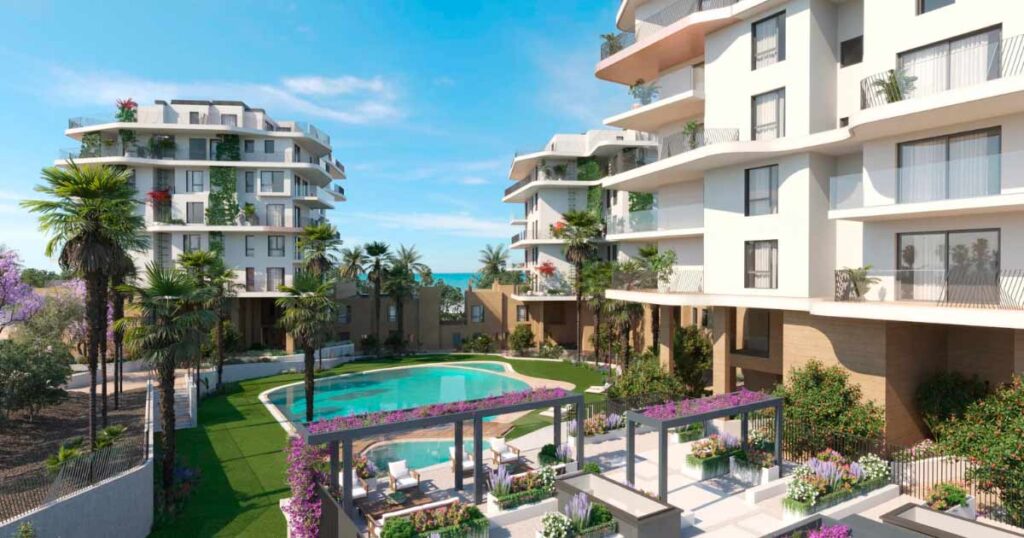
Prior to purchasing a property in Spain as a foreigner, it is vital to conduct comprehensive market research. Select properties that align with your personal requirements and possess essential features, such as proximity to the sea, bright interiors and sustainable recreational areas. These properties should also be constructed with high-quality materials and located in areas with convenient access to nearby amenities, including supermarkets, schools and healthcare facilities.
The Mediterranean coast is one of Spain’s most prominent regions, encompassing the Costa Blanca, Costa del Sol and Costa Cálida. These areas offer a wide range of property options, from apartments to luxury villas with sea views. The combination of natural beauty, a favourable climate and an excellent quality of life makes them an attractive proposition for both residents and investors.
Do you want to know which are the best cities to live in Spain as a foreigner? Don’t miss this previous Quadratia article.
Isabel Soriano, Sales and Marketing Office Coordinator at Quadratia
Get your NIE (Identification Number for Foreigners)

One of the fundamental prerequisites for purchasing a property in Spain as a non-resident is the acquisition of a NIE (Identification Number for Foreigners). This number serves as a crucial identifier, facilitating financial and legal operations within the country. It enables the completion of transactions such as property purchases and other legal procedures, including the registration of the property in your name.
The application process for a NIE is straightforward and can be completed at the Spanish embassy or consulate in your country or directly in Spain at the Foreigners’ Offices or Police Stations authorised for this procedure.
It should be noted that there are different types of NIE, and the appropriate one will depend on the individual circumstances of the applicant.
- A Non-resident NIE is suitable for those purchasing a property in Spain with the intention of spending less than 183 days a year there.
- A Resident NIE is required if you plan to live in Spain for more than 183 days.
- A Temporary NIE is recommended for EU citizens who will only be in Spain for the duration of the sale and purchase.
Book your investment property in Spain and formalise a reservation document

Once you have identified a suitable property, it is time to take the next step. The next requirement for purchasing a property in Spain as a foreigner is to sign a reservation document. This is a private agreement between the buyer and the seller that serves to reserve the property while the final sale is being formalised.
In essence, the initial deposit, typically ranging from €3,000 to €12,000, serves to reserve the property while the final sale is being formalised. However, this may vary depending on the state of the building work or the buyer’s conditions. The reservation document also includes essential details such as the maximum deadline for signing the deed of sale, the method of payment and any other conditions that both parties agree upon.
Choose the financing method that suits your needs

If you require financial assistance, it is essential to research the mortgage credit options available from both national banks and international entities with a presence in the country. Now that you have a clear understanding of the total cost, it is the ideal time to identify the mortgage that best suits your needs.
It is advisable to compare the offers and conditions of the various banks. Key factors to consider include interest rates (fixed, variable or mixed), fees and repayment terms. Interest rates can vary considerably between banks, and the recent ECB rate cut has resulted in more attractive conditions for both fixed and variable mortgages.
Open a bank account in Spain

One thing that is highly recommended is to open a bank account in the destination country. If you plan to buy a house in Spain as a non-resident, this account will allow you to facilitate deferred payments, such as those related to the purchase contract, and will simplify the process of complying with the money laundering prevention regulations established by Law 10/2010.
Similarly, it will be more convenient for direct debiting utility bills (water, electricity, gas, etc.) for future properties. It will also eliminate potential complications from international transfers, which often result in delays and additional fees.
Furthermore, the account will be instrumental in covering notary fees and other costs associated with the purchase, such as taxes and legal fees. With a local bank account, you will have comprehensive control and avoid potential issues at each stage of the transaction, ensuring a seamless and efficient process.
Formalises the contract of sale

The purchase contract is a crucial document in the process of purchasing a property in Spain by a non-resident. It contains essential information such as the final price, the method of payment, and the conditions for the handover of the property. It ensures that the acquisition of the property is conducted in a transparent manner and in accordance with the current legislation in Spain.
Signing of the public deed (handover of keys)

The purchase of a property in Spain is completed with the signing of the public deed in front of the notary. During this act, the buyer pays the outstanding amount for the property and the notary formalises the transfer of ownership. Once the deed has been signed, the buyer officially becomes the owner of the property. Once the deed has been signed, the keys are usually handed over, allowing the buyer to take possession of the property.
Register ownership

Once the title deed has been signed, the next step is to register the property in the name of the new owner at the Land Registry. This is a crucial step that provides legal security for the buyer and protects the ownership of the property. To register the sale and purchase, three documents are mandatory: the title deed, proof of payment of the corresponding taxes and a simple note from the Land Registry.
Taxes and costs associated with buying a house in Spain as a foreigner

When buying a property in Spain, foreigners must take into account various taxes and associated costs:
- VAT (Value Added Tax): Applies in the case of a newly built or first transfer property. The percentage is 10% of the value of the property.
- AJD (Impuesto de Actos Jurídicos Documentados): This tax is paid when signing the deed of sale and depends on the value of the property and the region where it is located.
- IBI (Impuesto sobre Bienes Inmuebles): This is an annual tax payable on the ownership of a property in Spain.
- IRPF or IRNR: If you are resident in Spain, you will pay IRPF. If you are non-resident, you will be subject to IRNR (Impuesto sobre la Renta de No Residentes), which applies to income derived from property.
In addition to taxes, additional costs include:
- Notarial deed.
- Registration of the property in the Land Registry.
- In the case of a mortgage, to cover the costs of valuation, notary and mortgage taxes.
For more information, see our previous article in which we detailed in depth the taxes when buying anewly built property in Spain.
Isabel Soriano, Sales and Marketing Office Coordinator at Quadratia
Bonus track: if I buy a house in Spain, do I get residency?
It is a common misconception that purchasing a property in Spain automatically grants residency. In fact, there are specific programmes, such as the Golden Visa, that facilitate this process. Until recently, foreign investors who purchased a property valued at a minimum of €500,000 were eligible to apply for this type of visa. This visa allows the holder to reside in Spain with their family, travel within the Schengen Area, and renew their permit without the need for an extended stay.
However, the Spanish government has announced the elimination of the Golden Visa for those who purchase real estate. This measure, which forms part of the reform of the Entrepreneurs Law, will restrict the granting of residency through the purchase of property.
While alternative avenues for residency, such as investment in business or proof of sufficient financial means, may remain, purchasing a home will no longer be the sole direct route to residency.
Find out more about the changes to the Golden Visa and the alternatives available in this other Quadratia article.
Isabel Soriano, Sales and Marketing Office Coordinator at Quadratia
Conclusions
In short, buying a property in Spain as a foreigner is an excellent investment opportunity. Whether you are looking for a property in Alicante (Costa Blanca), Malaga (Costa del Sol) or Murcia (Costa Cálida), opting for reliable developments such as those offered by Quadratia ensures that you acquire modern, quality properties.
As a leading developer of residential projects along the Mediterranean coast, Quadratia is a property developer that specialises in providing homes that combine comfort, design and sustainability. Our focus on these three key areas ensures that our customers make a solid and profitable purchase, with the backing of a company that has extensive experience in the Spanish property market.
Your dream of living in Spain starts at Quadratia.
What did you think of our article on the requirements for buying a house in Spain as a foreigner? Share our post and follow us on our social networks!


